From Planting Technical Parameters, Processing Control, to Combustion and Smoke Measurement — A Complete Chain of Key Technical Parameters in Tobacco
In the cognitive dimension of the tobacco industry, product quality is not the product of a single link, but a relay of parameters spanning the growth cycle, thermodynamic transformation, and fluid dynamic performance. From ion exchange in field soil, to moisture gradient transfer in the curing barn, to the smoldering chemical reactions at the moment of cigarette combustion, every tiny parameter fluctuation is amplified or compensated in subsequent links. Establishing a full-chain technical parameter system spanning "Planting—Processing—Combustion—Smoke" fundamentally means achieving a paradigm shift from "experience-based control" to "logic-driven" operation.
Chapter 1: The Chemical Foundation of Field Growth — The Decisive Role of Planting Parameters
The quality foundation of tobacco leaves is set from the moment the seed breaks through the soil. The core logic of the planting stage lies in precisely regulating the environment and nutrients to determine the chemical composition (such as nicotine, reducing sugars, proteins, and mineral elements) and their distribution ratios within the tobacco biomass.
1.1 Soil Environment and Nutrient Distribution Logic
High-quality tobacco leaves have nearly stringent requirements for soil physicochemical properties. Taking typical red soil regions as an example, maintaining soil pH between 5.5–6.5 is key to achieving nutrient availability. Once the pH drops below 5.0, the risk of aluminum toxicity increases, directly hindering root system development and subsequently affecting potassium (K) uptake in later leaf growth.
In nutrient management, the ratio of nitrogen (N), phosphorus (P), and potassium (K) is the core variable determining nicotine and reducing sugar content. Nitrogen fertilizer application must follow the principle of "light at first, heavy later, steady increase." Excessive nitrogen application, while increasing yield, leads to overly thick leaf tissue, high moisture content, and abnormally elevated nicotine levels, increasing the difficulty of downstream processing and the harshness of smoke.
1.2 Case Study: "Quality Collapse" Due to Nutrient Imbalance
In a field trial in a certain production area in the summer of 2023, we observed a typical case: due to excessive nitrogen fertilizer input in the early stage of this batch (pure nitrogen reaching 8 kg/mu), the tobacco plants showed obvious "excessive vegetative growth" after entering the budding stage. Rapid leaf scanning analysis revealed that the nitrogen content exceeded the growth model threshold by 20%, while potassium fertilizer ratios failed to keep pace. The result: although the leaf color was green, cell wall thickness increased, and mesophyll moisture content was abnormally high at maturity. During subsequent curing, these high-nitrogen, high-moisture, low-potassium leaves exhibited strong "yellowing resistance," forcing the curing cycle to be extended by nearly 30 hours. The final product showed a distinct "green odor" and elevated ammonia compounds, with severely degraded sensory quality. This demonstrates that nutrient ratio imbalance during the planting phase alters leaf tissue structure, creating chain reactions in processing that are difficult to compensate through conventional techniques.
Chapter 2: The Interweaving of Thermodynamics and Biochemical Reactions — Curing and Processing Control
If planting is "qualitative," then curing (baking and fermentation) is "quantitative." Curing processes, through precise thermodynamic control, drive enzymatic reactions and physical dehydration within the leaf, converting fresh tobacco into leaf tobacco with specific aroma and physical stability.
2.1 The Mathematical Essence of Curing: Precise Control of Moisture Gradient
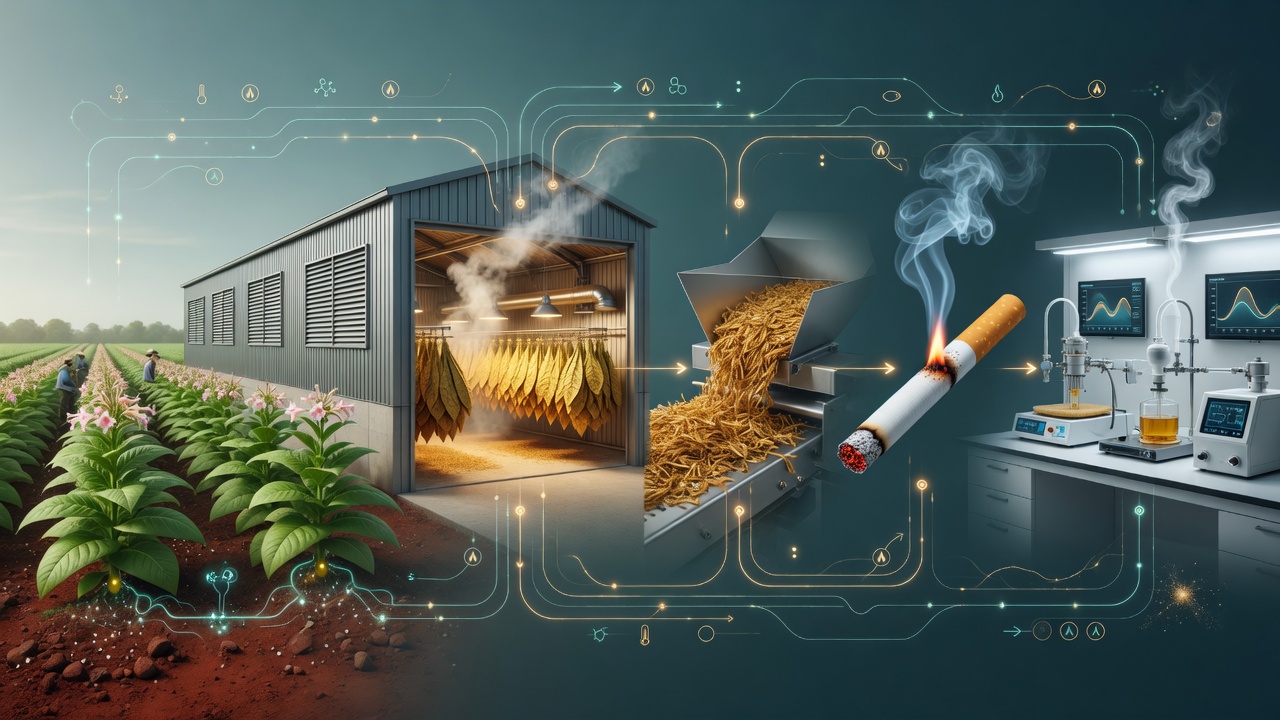
The mainstream three-stage flue-curing process — yellowing stage, color-fixing stage, and stem-drying stage — is essentially a phased removal of "free water" and "bound water" within the leaf.
2.2 Enzymatic Reactions and Chemical Transformation in Fermentation
Fermentation (aging) is the key step in reducing leaf irritancy and enhancing smoothness. By controlling temperature (45°C–55°C) and humidity (65%–75%), proteins are degraded into amino acids, starch is converted into reducing sugars, and abundant volatile aroma components are generated.
2.3 Case Study: "Redding" Accident Caused by Color-Fixation Stage Failure
In a production record review of a large-scale bulk curing barn, we discovered that a certain batch of leaves showed extensive "redding" (i.e., reddish color lacking golden hue). Parameter tracing revealed that the root cause was a sensor drift in the temperature control system during the color-fixation stage, causing an abnormal temperature pulse at 46°C that persisted for approximately 4 hours, with an instantaneous spike to 52°C. This temperature fluctuation disrupted the moisture gradient, causing excessively rapid moisture loss from the leaf surface, triggering oxidative stress reactions within the leaf and accelerating phenolic oxidation. This quality defect caused by thermodynamic parameter loss of control during processing manifested as uneven color in the subsequent cutting stage, and sensory evaluation revealed that the smoke had a distinct "scorched" note.
Chapter 3: Physical Structure and Combustion Dynamics — From Cut Tobacco to the Burning Cone
When tobacco leaves enter the cigarette-making stage, their physical structure parameters (such as cut ratio, filling value, moisture content) directly determine the dynamic performance of combustion.
3.1 The Impact of Cut Tobacco Physical Parameters on Smoldering
Excess Moisture
Absorbs combustion heat, lowers cone temperature, reduces LBR, incomplete combustion
Insufficient Moisture
Burns violently and unstably, cone temperature rises abnormally, harmful components surge
Cigarette combustion is a smoldering process — a complex oxygen diffusion and heat release process. The physical state of cut tobacco affects combustion through the following pathways:
3.2 The Microenvironment Within the Burning Cone
During combustion, a relatively stable oxygen-poor environment forms inside the burning cone. The dynamic balance between the heat release rate (HRR) and the oxygen diffusion rate determines the stability of smoke composition. Efficient combustion not only requires sufficient calorific value but also a stable heat release curve, avoiding sharp increases in harmful components caused by localized high temperatures.
Chapter 4: End-Feedback — Transfer and Traceability of Smoke Measurement Indicators
Smoke measurement is the final verification link in the technical parameter system. By monitoring core indicators such as tar, nicotine, and carbon monoxide (CO), we can trace backward the health of the entire production chain.
4.1 The TNCO System and Parameter Transmission
The core of measuring smoke quality lies in understanding the logical relationships between components. For example, fluctuations in nicotine content depend not only on nitrogen fertilizer input during the planting stage but are also constrained by the impact of moisture control during processing on nicotine migration.
4.2 Parameter Tracing: From End Indicators to Front-End Processes
Through big data modeling analysis, we discovered a significant parameter transmission pattern: the utilization rate of potassium (K) fertilizer during the planting stage is negatively correlated with the sensory irritancy of the end smoke. Insufficient potassium fertilizer during planting leads to decreased leaf tissue structural strength, making the leaves more prone to producing excessive fine fragments (Fines) during processing. These fragments significantly alter the permeability of the burning cone during combustion, causing non-linear fluctuations in CO and tar emissions. This transmission chain from "soil ions → plant tissue → physical fragments → combustion dynamics → smoke components" is the very essence of the full-chain parameter system.
Conclusion: Toward Parameter-Driven Precision Manufacturing
The tobacco industry is in a critical transition from experience-driven to data-driven operations. Establishing such a full-chain technical parameter system covering planting, processing, combustion, and measurement fundamentally means creating a "digital twin" logic. The future technological high ground will belong to intelligent enterprises capable of real-time acquisition of planting environment data through sensors, dynamic adjustment of curing curves using AI algorithms, and real-time correction of front-end processes through end-smoke feedback. Only by achieving closed-loop parameter control can extreme quality stability be realized under extremely high production consistency requirements.